
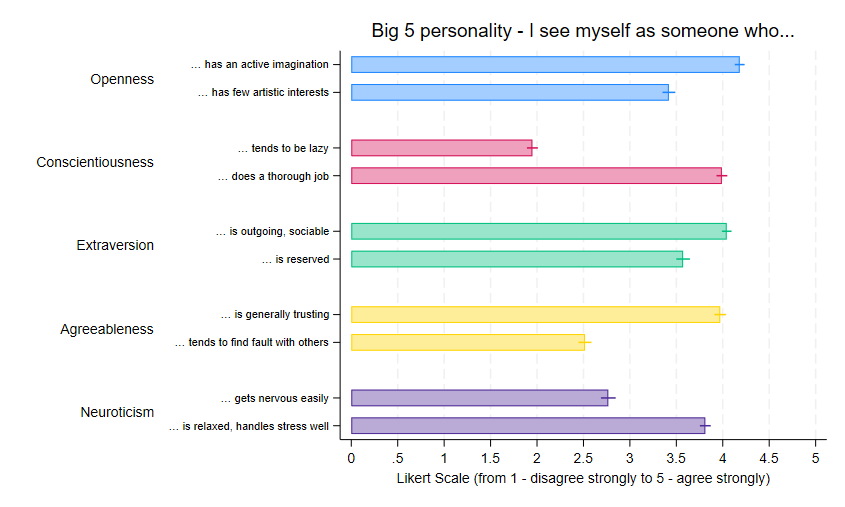
What do young people in Uganda say about themselves? As part of our ongoing panel survey, we asked nearly 1,000 young adults to reflect on their personalities using the well-known Big Five framework: Openness, Conscientiousness, Extraversion, Agreeableness, and Neuroticism. Each respondent was asked to which degree they agree on each statement on a Likert scale of 1 to 5, where 1 corresponds to disagree strongly and 5 corresponds to agree strongly. We then summarize the responses, including the average scores for each item, which give us a fascinating glimpse into how the next generation sees itself.
Openness: Imaginative and Creative
Youth scored highest on openness, especially when describing themselves as having an active imagination (average 4.18/5). While some reported having “few artistic interests” (3.42/5), overall, the results suggest a generation that values creativity and new ideas.
Conscientiousness: Hardworking and Reliable
When it comes to responsibility and discipline, youth consistently see themselves as conscientious. Most reported that they do a thorough job (3.99/5), and very few agreed that they tend to be lazy (1.95/5). Together, these responses suggest a generation that values effort, reliability, and diligence.
Extraversion: Sociable Yet Thoughtful
Young people described themselves as sociable and outgoing (4.04/5),but they also rated themselves moderately high on being reserved (3.57/5). This combination reveals a nuanced profile: while Ugandan youth enjoy social interaction and connecting with others, they also retain a reflective, thoughtful side.
Agreeableness: Trusting and Cooperative
On average, youth see themselves as generally trusting (3.97/5) and not overly fault-finding (2.52/5). This combination suggests a spirit of cooperation and openness to others. Ugandan youth appear to value collaboration, empathy, and maintaining positive relationships — qualities that are essential for building strong social and community networks.
Neuroticism: Managing Stress
When it comes to stress and anxiety, youth reported moderate levels of nervousness (2.77/5) but also rated themselves highly on handling stress well (3.81/5). This paints a picture of resilience: while they experience stress like anyone else, many feel capable of managing it effectively.
Conclusion
These results give us a window into the personalities of Uganda’s youth beyond education and work. The Big Five findings show a generation that is open and imaginative, conscientious, sociable but also reflective, cooperative and trusting, and resilient under stress. Together, these traits highlight a strong potential for creativity, collaboration, and adaptability. By following these young people over time, Your Path will continue to learn how personality influences their journeys and how these qualities shape their families, communities, and futures.
.svg)
.svg)